
How to Teach Beginning Sounds at Home (Without Worksheets)
If you've got a four or five year old, you've probably heard the phrase "beginning sounds" at nursery pickup or in a school newsletter — usually alongside a gentle suggestion that you might practice at home.
And if you've ever tried to practice at home, you'll know how that can go. The worksheet comes out. The bottom lip comes out. Everyone ends up a bit cross, including you.
Here's the thing, though: at this age, beginning sounds don't need a worksheet at all. Hearing the first sound in a word is a listening skill, not a writing one — which means most of the best practice happens through talking, playing, and pottering about together. No table required.
Here are the ways that worked for us, most of which cost nothing at all.
Why beginning sounds matter (briefly, I promise)
Before children can read words, they need to hear that words are made of sounds — and the first sound is the easiest one to catch. When your little one can hear that "sun" starts with sss, they've taken one of the first real steps towards reading. That's it. That's the whole goal. Everything below is just ways to practice it without anyone noticing they're practicing.
1. Play "I hear with my little ear"
Classic I Spy, but with sounds instead of letter names: "I hear with my little ear, something beginning with mmm." Stretch the sound out. Do it in the car, in the bath, in the supermarket queue. Thirty seconds counts.
2. Go on a sound walk
Pick one sound before you leave the house — say, sss — and hunt for things that start with it on the way to the park. Sky, sticks, snails, socks (there's always a sock). Little ones love having a mission.
3. Sort the shopping
Unpacking the bags? Ask them to find you everything that starts with b. Bread, bananas, beans, butter. You get the shopping put away; they get sound practice. Everyone wins.
4. Say it slowly, and let them catch it
When a tricky word comes up, stretch the first sound like warm toffee: "fffff-fox." Then let them have a turn stretching one for you. Taking turns matters — children listen harder when they know they'll be the teacher next.
5. Raid the toy basket
Gather a handful of toys and sort them into two piles: things that start with your sound, and things that don't. The "don't belong" pile is secretly the important one — deciding something doesn't start with mmm takes more listening than spotting something that does.
6. Feed a hungry animal
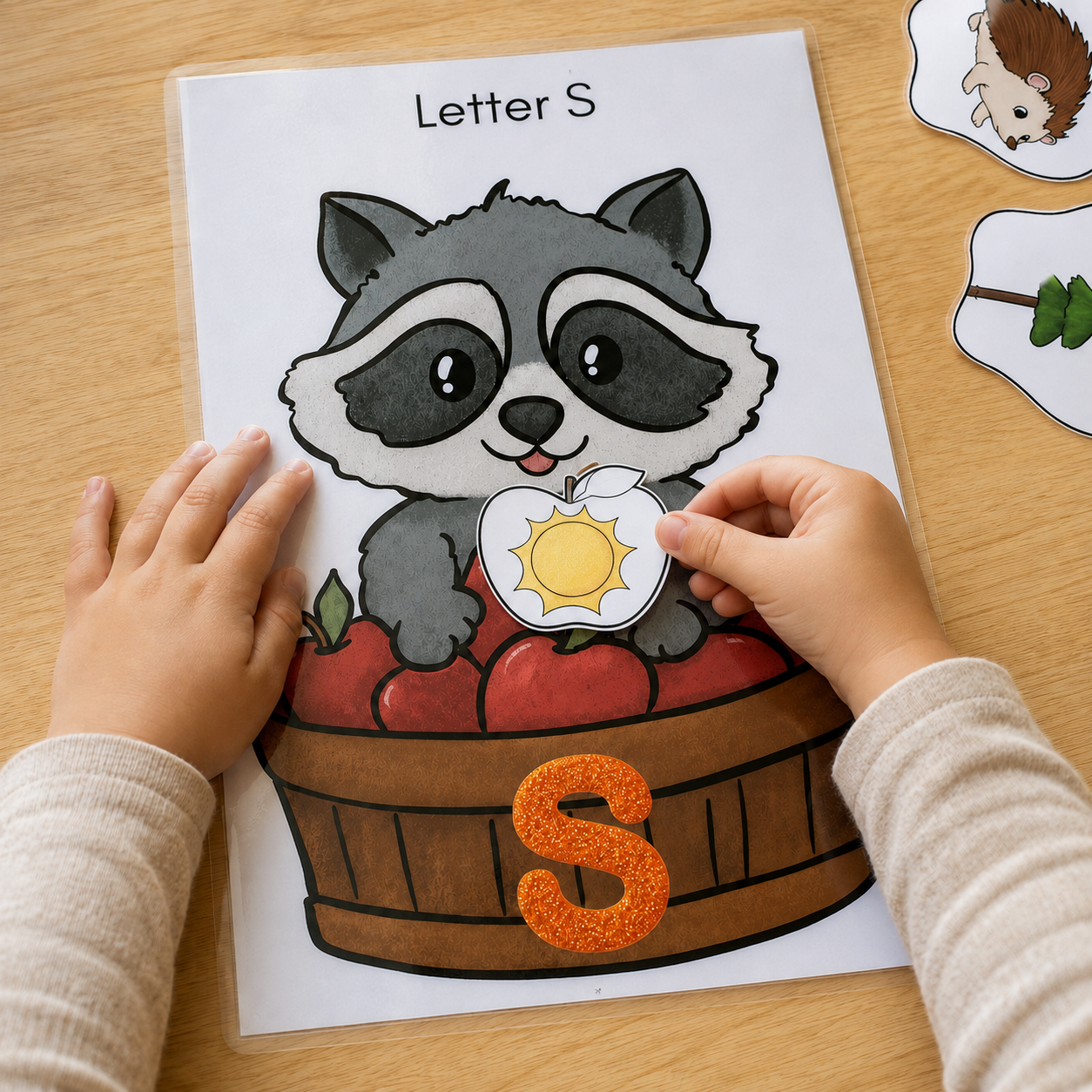
This one's the reliable favourite in our house. Take any soft toy, declare that it only eats things beginning with one sound, and let your little one "feed" it — toys, pictures, anything. There's something about feeding a creature that makes children forget it's practice entirely.
If you'd like a ready-made version, this is exactly why I made Feed the Raccoon!— a printable woodland sorting game where a very hungry raccoon will only eat the apples that start with his letter. There are five letter mats (S, M, F, C and B, plus a blank one for any letter you're working on), six apple picture cards for each sound — including two sneaky ones that don't belong — and five early-finisher colouring and drawing pages for afterwards. Print it, laminate it if you'd like it to last all year, and it's ready whenever you need ten calm minutes. It comes in A4 and US Letter, and it's an instant download — you could be playing it this afternoon. It's on Etsy too, if that's easier.
7. Keep it tiny
Five minutes is plenty. Truly. Little and often beats one long session every time — and stopping while it's still fun is what makes them ask to play again tomorrow.
8. Follow their obsessions
Dinosaurs? Practise d. Unicorns? That's u sorted. Sounds stick faster when they're attached to something your child already loves talking about.
9. Sing it
Swap the first sound of a favourite song's words and let them giggle at "Baa Baa Purple Sheep" becoming "Maa Maa..." — hearing what's wrong with a word is brilliant sound awareness in disguise.
10. Let them be the raccoon
Whatever game you play, swap roles sometimes. Let them choose the sound, test you, and catch your deliberate mistakes. ("Does 'apple' start with sss? It DOES NOT, Mummy.") Being the expert is the best confidence-builder there is.
A gentle last word
If your little one isn't hearing beginning sounds yet, that's okay. This skill arrives in its own time, and pushing rarely hurries it — it just makes the kitchen table a battleground. Keep it playful, keep it short, and trust that all these small silly moments are quietly adding up.
And if a hungry raccoon would help, he's right here, apples at the ready. You can also browse the rest of my shop or join my email list for new printables and gentle ideas like these.
Happy sound-hunting. 💛
Lucy x
Fun Printables 4 Kids
