
How to Help a Nervous Child Feel Ready for School (Without Pressure)
If there's a little one in your life who goes quiet when school is mentioned, or suddenly has a hundred questions at bedtime — "What if I don't know anyone? What if I can't find the toilets?" — you're not alone, and neither are they. First-day nerves are one of the most common things children feel at this time of year, and they're also one of the most normal.
The good news? Children don't need us to fix their worries. They need us to walk alongside them while they feel them. Here are some gentle, practical ways to do exactly that — whether you're a parent, a grandparent, or someone who cares for a small person you love.
1. Let the routine do the reassuring
Children feel safest when they know what's coming next. In the last week or so before school starts, you don't need a strict schedule — just a few familiar rhythms that quietly say "you've got this":
- Shift bedtime and wake-up time gradually towards school hours, ten or fifteen minutes at a time
- Practice the morning routine once or twice, without any rush — getting dressed, breakfast, shoes, out the door
- Walk or drive the school route together, pointing out friendly landmarks ("that's the red postbox near your school!")
- Let them pack and unpack their school bag themselves, so it feels like theirs
The magic here isn't the routine itself — it's the repetition. Every time a child does something familiar, their brain files it under "safe". By the first morning, half of the day already feels known.
2. Talk about feelings — but keep it light
When a child says "I don't want to go to school," it's tempting to jump straight to reassurance: "You'll be fine! You'll love it!" It comes from love, but to a worried child it can accidentally sound like "your feeling is wrong."
Instead, try naming the feeling first:
> "It sounds like you're feeling a bit wobbly about starting school. That makes sense — new things can feel big."
That one small pause — feeling first, fixing second — tells a child their emotions are allowed. Then you can gently add the reassuring part: "Lots of children feel that way, and the wobbly feeling usually gets smaller once you're there."
A few more low-pressure ways in:
- Chat side-by-side rather than face-to-face — in the car, on a walk, while colouring together. Big feelings come out more easily when little eyes don't feel watched.
- Share your own (small!) version: "I remember feeling nervous on my first day. My tummy felt like butterflies. And then I made a friend at lunchtime."
- Ask what they're looking forward to, as well as what they're worried about. Both feelings can be true at once, and it helps children to know that.
3. Make school familiar through play
For young children, play is how they rehearse life. Playing "schools" at the kitchen table — with teddies as classmates and a grown-up as the slightly silly teacher — lets a child practice the whole day in a world where they're completely in control. Register, story time, snack time, lining up, asking to go to the toilet (a genuinely big worry for lots of little ones — practice the asking part!).
You can also:
- Read picture books about starting school and let them ask questions along the way
- Try on the uniform for a "dress rehearsal" and make it fun rather than formal
- Do a teddy bear school run, where teddy is the nervous one and your little one gets to reassure him
That last one is quietly powerful. When a child comforts a worried teddy, they're really rehearsing comforting themselves.
4. Give big feelings a quiet way out
Not every child can tell you how they feel — and that's okay. Little ones often don't have the words yet for the big things happening inside them. That's where quiet, hands-on activities really earn their keep.
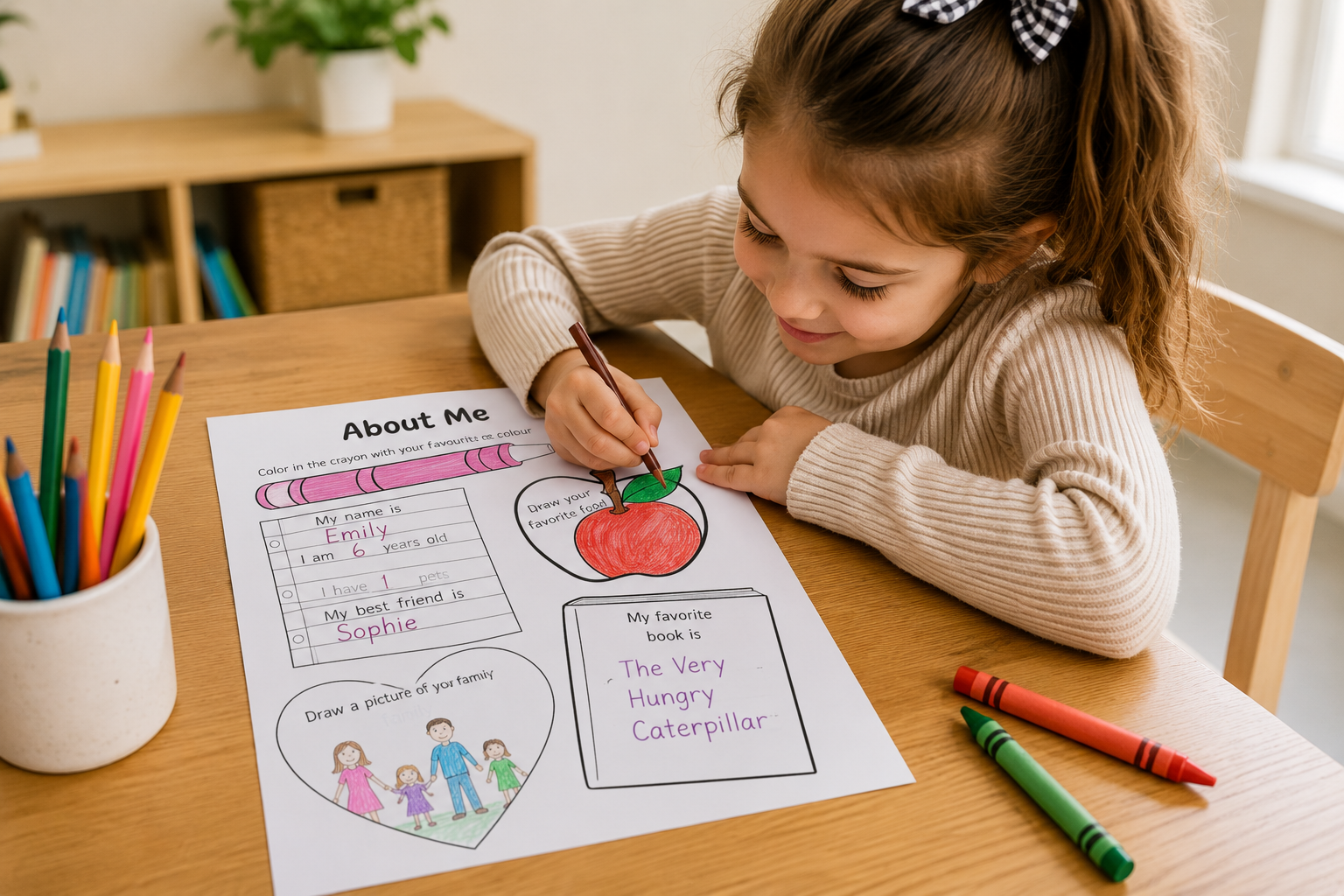
Drawing and colouring give children a calm, gentle way to process feelings that are too big or too muddled to say out loud. A child who can't tell you they're nervous can often draw how their tummy feels, or colour quietly beside you while the worries slowly untangle themselves. There's no pressure to perform, no right answer — just crayons, paper, and a bit of peace.
Some lovely low-key ideas for the week before school:
- Draw a picture of "my new school" or "my new teacher" to make the unknown feel more known
- Colour a "how I'm feeling today" page together and chat about the faces
- Make an "All About Me" sheet they can take in to share with their new teacher — a little bridge between home and school
If you'd like something ready to print, you'll find gentle, school-ready activity sheets and colouring pages in the Fun Printables 4 Kids shop — all designed to be printed at home in minutes, no screens required. Pop one on the table with some crayons and let the conversation come to you.
5. And on the big morning itself…
Keep it simple. A calm breakfast, a hug that isn't rushed, and a short, confident goodbye. Long, lingering goodbyes — however lovingly meant — tend to grow the wobbles rather than soothe them. A quick "I love you, have a wonderful day, I'll see you at pick-up" tells a child you believe they'll be okay. And children borrow their bravery from us.
If there are tears at the gate, take heart: they almost always dry within minutes of walking in. The child crying at drop-off is very often the one giggling at snack time.
One last thing
You can't take away every worry — and you don't need to. Every time you listen without rushing, play school with a teddy, or sit quietly colouring together, you're teaching the child in your life something far bigger than how to survive the first day. You're teaching them that new things can feel scary and turn out wonderfully — and that there's always someone in their corner.
That's what really makes a child school-ready. And you're already doing it. 💛
Know a parent, grandparent, or childminder with a little one starting school this September? Share this post with them — sometimes a bit of gentle reassurance is exactly what the grown-ups need too.
