
Why Kids Freeze at the Blank Page (And How to Help Them Find Their Words)
"Write about your weekend."
It sounds like such a small, friendly instruction. Your child did things this weekend. They could tell you about every one of them, in detail, at length, usually at the exact moment you're trying to get them out the door. And yet hand them a blank page and ask them to write it down, and something shuts. The pencil hovers. The sighing starts. "I don't know what to write."
If that scene plays out at your kitchen table most weeks, here's the reassurance to start with: it isn't that your child has nothing to say, and it isn't laziness. The blank page freeze is almost always about idea generation, not imagination. Children are rarely taught how to go from "a big pile of things that happened" to "one small thing worth writing about," and without that specific skill, a blank page feels less like an invitation and more like a test with no visible questions.
By this point in the autumn term, with the settling-in weeks behind us and the evenings drawing in enough that more of family life happens indoors, this particular battle tends to show up a lot. Weekly writing homework has usually started in earnest, reading records want a few lines filled in, and there's more cosy kitchen-table time generally, which is exactly when "I don't know what to write" gets its loudest airing.
Key Takeaways
- Most "reluctant writers" aren't short on ideas. They're short on a method for finding one worth starting with, and nobody's ever shown them how.
- The inner critic that says "that's a stupid idea" switches on long before the pencil touches the page, and it's usually that, not the writing itself, that causes the freeze.
- Short, low-pressure writing bursts build the skill faster than long, "proper" pieces that feel high-stakes.
- Journalling and informal writing carry real benefits beyond literacy, including helping children process feelings and reduce stress, which matters as much as the writing skill itself.
- A good prompt does the hard part for your child. It narrows "everything" down to "one specific thing," which is often all the help a stuck writer actually needs.
What's Really Going On
Here's the thing nobody quite says out loud: writing is one of the only school tasks that asks a child to do several difficult things at once, and asks them to do it in the right order. First, think of an idea. Then, decide if the idea is any good. Then, work out how to start the sentence. Then, remember the full stops, the capital letters, the finger spaces, the spelling, while the original idea is still sitting there, half-formed, waiting to be let out.
Most of us, as adults, would also freeze under that stacking of demands. Think about the last time you sat down to write a difficult email and typed, deleted, and retyped the first line four times before you'd got anywhere. Children are doing a version of that, with far less practice and a far louder inner critic, every single time they're handed a blank page.
I think about this a lot from my years working with young children, both in nurseries and as a nanny, and later watching my own daughter navigate school writing tasks. The children who seemed most "reluctant" were almost never short of things to say. Ask them a specific, narrow question, "what was the funniest thing that happened at lunch?", rather than the enormous, shapeless "write about your weekend," and the words came pouring out. The problem was never the content. It was that nobody had narrowed the field for them first.
The Evidence for Starting Smaller, Not Pushing Harder
Teachers who specialise in supporting reluctant writers consistently land on the same core insight: the issue isn't a lack of creativity, it's a lack of explicit instruction in how to generate an idea in the first place. Writing specialists describe "ideas" as the heart of the matter, something that has to be taught step by step, the same way spelling or punctuation is taught, rather than something a child is simply expected to produce on demand.
One strategy teachers use again and again is to strip the pressure right back before asking for a finished piece at all. Quick, low-stakes bursts, just a few minutes, using a single word or image as a jumping-off point, "warm up the idea generation muscle" without the stakes of a full piece of writing attached. The goal in those few minutes isn't a polished paragraph. It's just proving to a stuck writer that an idea can arrive quickly and doesn't have to be perfect to be worth putting down.
There's also a wellbeing side to this that's easy to overlook when you're just trying to get a reading record filled in before bath time. Journalling and informal, low-pressure writing are linked to real benefits for children beyond literacy: helping them process difficult feelings, name what they're actually worried about, and get some of the noise out of their heads and onto a page instead of carrying it around all evening. For a child who finds the day hard to put into words out loud, writing can sometimes do what talking can't.
None of this means ditching "proper" writing practice. It means recognising that the quickest route to a confident writer is usually through dozens of small, low-pressure attempts, not one big, high-stakes one.
The Shift That Actually Helps
The temptation, when a child says "I don't know what to write," is to offer bigger and more detailed instructions. "Well, what did you do on Saturday? Did you go anywhere? What about the park, you could write about the park." Each suggestion is well-meant, and each one also keeps the decision sitting with your child, who is already stuck precisely because that decision feels too big.
The shift that actually works is to take the decision away from them entirely, at least at first. Not "what do you want to write about?" but "write two sentences about the bit where the dog ran off with your sock." You've done the hardest part of the task for them: narrowing an overwhelming "everything" down to one small, specific, already-interesting thing. From there, most children can write. The freeze was never really about writing. It was about choosing.
This is also where a bit of structure earns its keep. A page that already has a prompt, a small space, and permission to write just a little, does the same narrowing job as a good question, without you having to come up with a fresh one every single evening. I built the Autumn Colouring and Creative Writing Journal with exactly that gap in mind: gentle prompts alongside colouring pages for ages 7 to 11, so a child can ease into a few lines of writing without the blank page ever actually being blank.
What To Actually Do
1. Ask a narrow question, not a broad one. Swap "how was your day?" or "write about your weekend" for something specific: "what was the funniest thing someone said today?" or "describe the best bit of your Saturday in three sentences." Specific questions do the hardest part of the thinking for your child.
2. Keep the first attempt short and genuinely low-pressure. Two or three sentences, with no expectation of a finished "piece," gets a reluctant writer moving far faster than a request for half a page. You're building the habit of starting, not demanding a polished result.
3. Let them talk it through before they write it down. A minute or two of chatting about the idea out loud, "oh, tell me about that," lets your child find the shape of what they want to say before they have to wrestle it onto paper. The writing becomes transcription of something they've already worked out, which is a much smaller ask.
4. Separate the idea from the spelling and punctuation. If your child has an idea but gets stuck worrying about how to spell a word or where the commas go, tell them to just get the idea down first, in any form, and you'll tidy the details together afterwards. Perfectionism about mechanics is one of the biggest silent killers of a child's willingness to start.
5. Use prompts that remove the "what" entirely. Keep a small stock of ready-made starting points, a single interesting word, a "what if," a specific memory question, so you're never standing there blank yourself, trying to invent a fresh prompt on the spot while your child waits.
6. Praise the starting, not just the finished sentence. "You got straight on with that" matters more to a reluctant writer's confidence than a comment on handwriting or spelling ever will. You're reinforcing the behaviour you actually want more of: beginning without a fight.
7. Let some writing exist purely for your child, not for marking. A journal, a diary, a notebook that nobody's going to correct, gives a child somewhere to write without the pressure of getting it "right," which is often where the real enjoyment of writing starts to creep back in.
A Few Prompts to Keep in Your Back Pocket
It helps enormously to have two or three of these ready before "I don't know what to write" even has a chance to be said. You don't need many, just enough that you're never standing there inventing one on the spot.
- "What's one thing that made you laugh today?"
- "Describe the weather today as if you were a weather reporter."
- "If your pet (or a toy) could talk for one hour, what would it say?"
- "Write three sentences about the best five minutes of your day."
- "What's something you're really good at, and how did you get good at it?"
- "Describe your bedroom to someone who's never seen it."
- "Write about a time something went wrong and it turned out okay."
Notice none of these ask "what do you want to write about?" They all hand your child a specific, narrow doorway in, which is exactly what a stuck writer needs most.
Want more to keep on hand? I've put together a free printable list, 20 No-Pressure Writing Prompts (sorted into Everyday Moments, Silly & Fun, Tell Me About..., What If...? and Feelings & Thoughts), so you've always got a ready-made starting point to hand your child. Pop it on the fridge or keep it by the homework table.
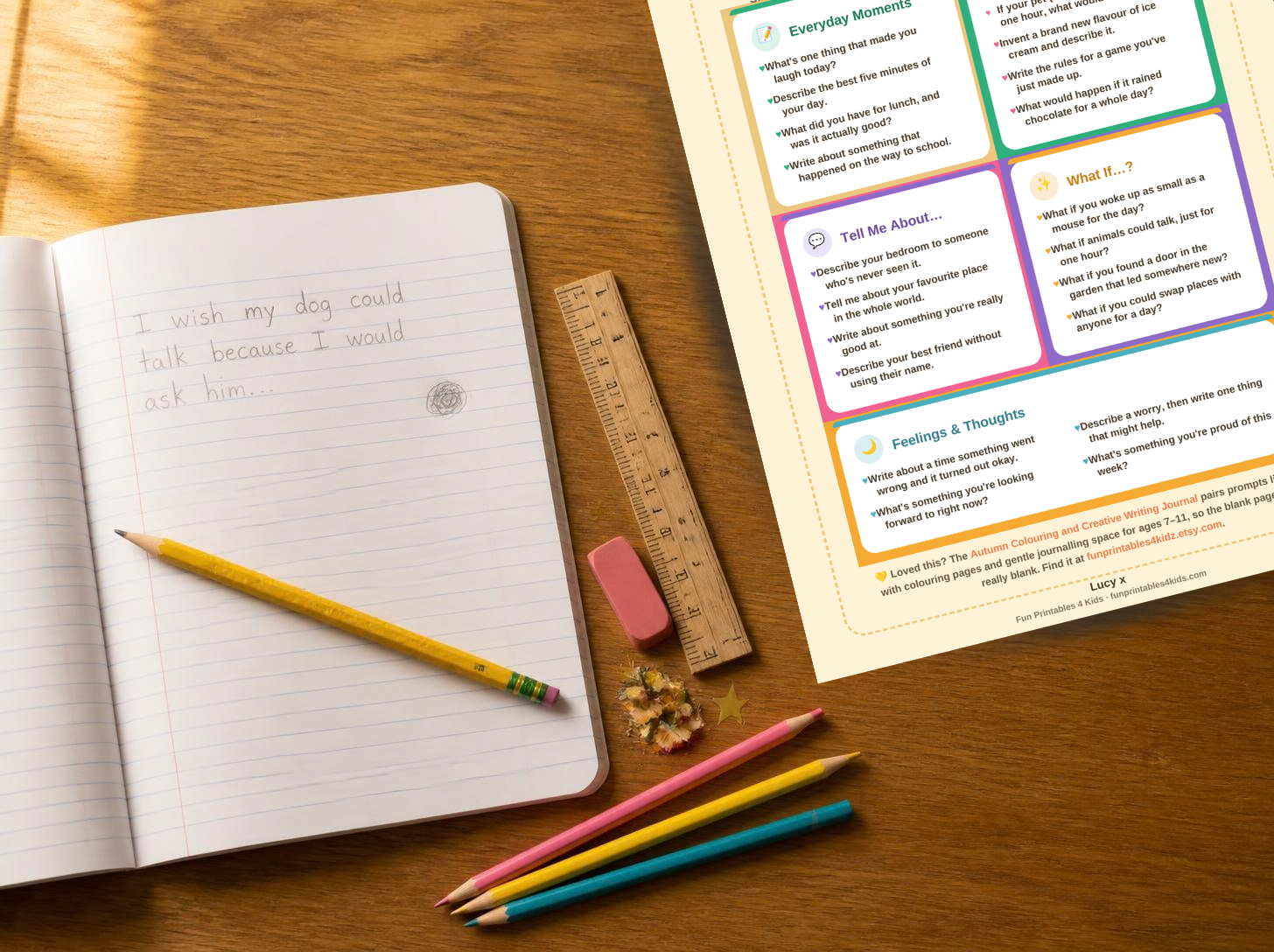
Use prompts that remove the "what" entirely. Keep a small stock of ready-made starting points, a single interesting word, a "what if," a specific memory question, so you're never standing there blank yourself, trying to invent a fresh prompt on the spot while your child waits.
Frequently Asked Questions
My child can talk for hours but goes completely blank with a pencil in hand. Is that normal? Very. Speaking and writing use overlapping but different skills, and writing adds the extra load of forming letters, spelling, and punctuation on top of the thinking. A child who's articulate out loud can absolutely still freeze on paper, and it usually has nothing to do with how much they actually have to say.
Should I be worried this means a specific learning difficulty? Not necessarily. Most children go through a reluctant-writer phase, and it often eases with exactly the kind of low-pressure practice described above. If your child's reluctance is extreme, persistent across many months, or comes with other signs like real difficulty forming letters or reading, it's worth a conversation with their teacher, simply to check whether any extra support would help.
Is it bad that my child only wants to write about the same topic over and over? No. A child who writes repeatedly about football, a particular game, or their pet is building fluency and confidence in a space that already feels safe. Variety can come later. Confidence comes first.
How much writing practice at home is actually useful? A few short, enjoyable bursts a week do far more than one long, dreaded session. Five genuinely low-pressure minutes, done consistently, beats a weekly half-hour battle every time.
What if my child says they just don't like writing at all? That's often less about writing itself and more about which kind of writing they've been exposed to. A child who hates "write a story" might come alive with a joke book, a fact file about dinosaurs, or a diary nobody else reads. The dislike is usually of the format, not the act of putting words down.
Before You Go
If "I don't know what to write" is a regular stand-off in your house right now, you're not dealing with a child who lacks imagination, and you're definitely not doing anything wrong. You're dealing with a child who hasn't yet been handed the one tool that makes the whole thing possible: a way to turn "everything" into "one small thing."
Give them that, consistently, in small doses, with zero pressure for it to be good, and the words tend to find their way out on their own. They were always in there. They just needed somewhere smaller to start.
